
The Greek Salad (Horiatiki) is a masterpiece of universal culinary heritage, celebrated from the sun-drenched islands of the Aegean to the modern gastro-cafés of London, New York, and Dubai. Every bite offers a different journey: the crisp, cooling “snap” of Persian cucumbers, the salty, cream-like crumble of premium feta, and the sun-ripened sweetness of vine-grown tomatoes.
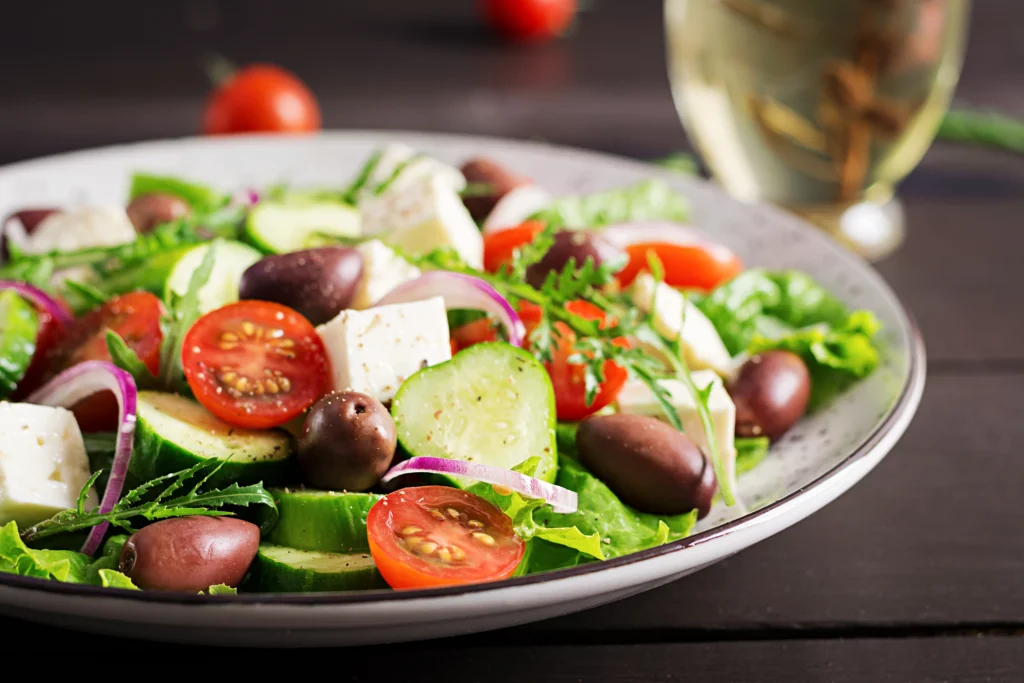
Consuming this dish is an exercise in sensory purity. The journey begins with the bright, earthy aroma of oregano and olive oil, followed by the audible “crunch” of the fresh pepper and cucumber. As you reach the center, the texture shifts to the melt-on-the-tongue saltiness of the feta, punctuated by the savory, wine-like depth of the olives. It is an honest, comforting ritual that captures the essence of modern dining culture—unpretentious, vibrant, and deeply satisfying.
The Culinary Heritage
In culinary circles across the world, the Greek Salad represents the pinnacle of “curated dining” that bridges the gap between rugged Mediterranean staples and high-end gourmet excellence. While the ingredients are raw and unpretentious, the assembly is a sophisticated lesson in contrast—balancing the heavy, brine-forward richness of Kalamata olives with the vibrant, herbaceous “pop” of wild dried oregano.
This dish has moved beyond its village origins to become a featured specialty in high-end urban eateries, where the focus is on provenance and artisanal craftsmanship. The appeal lies in its clean, structural beauty and social nature; it is a masterclass in ingredient integrity, demonstrating how raw vegetables can be transformed into a bold, restaurant-quality masterpiece for any social occasion.
For a hearty lunch pairing, try our London Caesar Salad with Crispy Chicken
Chef’s Preparation Notes
To ensure your Greek Salad hits professional standards, keep these tips in mind:
- The No-Lettuce Rule: A traditional Horiatiki never contains lettuce. The focus should remain entirely on the density and juice of the vegetables.
- The “Shatter” Technique: Instead of cubing your feta, place a thick, solid slab on top of the vegetables. This allows the diner to “shatter” the cheese into the dressing.
- Red Onion Tempering: To remove the harsh “bite,” soak the slices in ice water for 10 minutes before adding them to the salad.
- Oil Provenance: Use the highest quality Extra Virgin Olive Oil you can find. Since this is a raw dish, the oil acts as a primary flavor carrier.
The Authentic Recipe
Serves: 4
Total Time: 20 minutes
Flavour Profile: Fresh, salty, tangy, and herbaceous
Ingredients
- 4 large vine-ripened tomatoes, cut into irregular wedges
- 2 medium cucumbers, partially peeled and sliced into thick half-moons
- 1 small red onion, thinly sliced into rings
- 1 green bell pepper, de-seeded and sliced into rounds
- 100g Kalamata olives (whole and pitted)
- 200g block of premium sheep’s milk Feta cheese
- For the Dressing:
- 4 tablespoons high-quality Extra Virgin Olive Oil
- 1 tablespoon red wine vinegar
- 1 teaspoon dried wild oregano
- A pinch of sea salt and cracked black pepper
Instructions
- Prepare the base: In a large, shallow ceramic bowl, combine the tomatoes, cucumbers, green pepper, and red onions. Toss gently by hand to ensure the juices begin to mingle at the bottom of the bowl.
- Add the brine: Scatter the Kalamata olives over the vegetable medley.
- The Emulsion: In a small glass jar, whisk together the olive oil and red wine vinegar. Pour the dressing evenly over the salad.
- The Finishing Touch: Place the whole block (or large chunks) of feta cheese directly on top. Season the cheese generously with the dried oregano and a final crack of black pepper.
- Serve: Drizzle one last teaspoon of olive oil over the feta and serve immediately.
🍽 Presentation & Pairing
Greek Salad is best served at room temperature to allow the tomatoes to release their maximum flavor. For a café-style presentation, serve in a rustic clay bowl alongside a basket of warm, crusty bread to soak up the juices left at the bottom. It pairs beautifully with grilled lamb, roasted fish, or a chilled glass of dry white wine.
Nutritional Overview*
- Per serving:
- Calories: 260 kcal
- Protein: 8 g
- Carbohydrates: 10 g
- Fat: 22 g
- Fiber: 3 g
- Sodium: 580 mg
*Nutrition data is calculated by an automated system and may vary, so it is provided as an estimate.
Greek Salad remains a cherished globel classic because of its ability to comfort and satisfy with simple ingredients. Smooth, nourishing, and easy to prepare, it captures the essence of artisanal café dining—unpretentious, warm, and deeply satisfying.