
The British Pancake is a masterpiece of minimalist baking, traditionally celebrated on Shrove Tuesday but cherished year-round in homes across the United Kingdom. Unlike their thicker American cousins, these pancakes are defined by their delicate, crêpe-like thinness and the iconic “golden lace” pattern that forms across their surface. A perfect British pancake is a balance of textures: slightly crisp at the feathered edges, yet soft and supple enough to be rolled or folded around a variety of sweet or savory fillings.
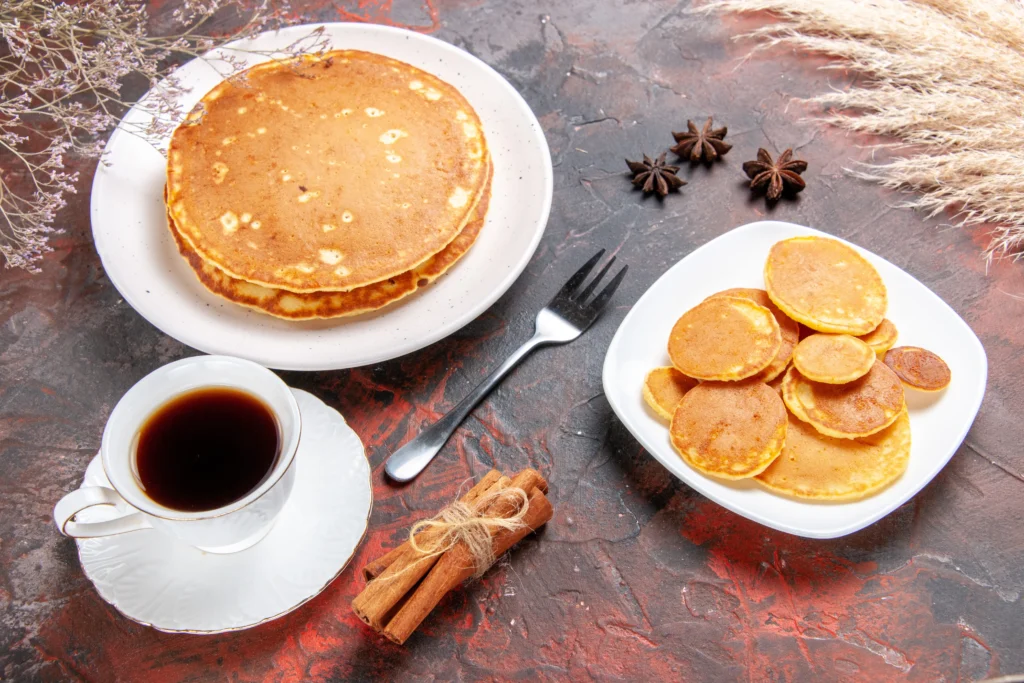
Delicate Texture & Golden Finish
The British pancake is a masterclass in simplicity, favoring a silky, flexible texture over the height of American versions. Without chemical leaveners like baking powder, it relies entirely on the correct ratio of eggs to flour and a high-heat sear to achieve its signature golden-laced finish.
The secret to its delicate texture lies in the “Long Rest.” Resting the batter for 30 minutes allows gluten to relax and starch to hydrate, ensuring the pancake is tender enough to fold or roll without tearing. When cooking, the pan must be hot enough that the batter “shimmers” as you swirl it. This rapid heat creates a beautiful “leopard-spot” browning—the iconic golden finish—while keeping the pancake paper-thin.
Unlike the syrup-heavy American style, the British version is traditionally served with fresh lemon and granulated sugar. The acid from the lemon cuts through the richness of the eggs, while the sugar provides a subtle crunch against the soft, buttery folds. It is a light, elegant dish that balances a crisp, frilled edge with a meltingly soft center, proving that sometimes, less is significantly more.
About me
Based in London, [Name] is a recipe developer and food photographer who has led the culinary conversation at [Site Name] since 2025. With over a decade of experience, He specializes in creating triple-tested, accessible recipes that bring gourmet flavors to the everyday home kitchen.
Delicate Texture & Golden Finish
The British pancake is a study in culinary minimalism, relying on a basic 1:1:1 ratio—typically one cup of flour, one cup of milk, and one large egg. Unlike the complex, bubbly chemistry of buttermilk versions, the British pancake (or “shrove” style) is unleavened. Its beauty lies not in height, but in its paper-thin flexibility and crispy, frilled edges.
The magic of this simple three-ingredient batter is found in the structural transition during cooking. Without baking soda to create lift, the batter spreads thinly across the pan. As the moisture evaporates rapidly over medium-high heat, the edges become dehydrated and “lacy,” creating a satisfying snap that contrasts with the soft, custard-like center.
The final “British” touch is the serving method: a simple sprinkle of granulated sugar and a sharp squeeze of fresh lemon juice. This avoids the heavy, cloying sweetness of syrups, allowing the clean flavors of the toasted flour and butter to shine. It is a humble, centuries-old technique that prioritizes a perfect “fold” over fluffiness, proving that you don’t need a crowded pantry to create a perfect golden finish.
Techniques for Thin, Even Pancakes
Achieving the perfect British pancake—translucent, uniform, and without “thick spots”—relies on viscosity control and kinetic movement.
1. The Consistency Check
The batter must be thin enough to run like heavy cream. If it’s too thick, it won’t spread fast enough; if it’s too watery, it will tear.
- The Test: Dip a spoon into the batter; it should coat the back thinly but disappear almost immediately when you run a finger through it.
2. The “Off-Heat” Pour
Never pour batter into a pan sitting directly on the flame.
- The Technique: Lift the pan and hold it at a 45-degree angle. Pour the batter into the “high” side of the pan. This uses gravity to start the spread before the heat can set the proteins.
3. The Circular Wrist-Flick
Movement must be immediate and fluid.
- The Technique: As soon as the batter hits the pan, rotate your wrist in a wide, circular motion to “chase” the batter around the entire circumference. Aim to finish the swirl just as the batter reaches the edges.
4. Controlled Fat Application
Excess oil causes the batter to “bead” rather than spread evenly.
- The Technique: Use a silicone brush or a paper towel dipped in oil to “buff” the pan. You want a matte shimmer, not a shimmering pool. This ensures the batter grips the surface for an even, golden cook.
Classic British “Lemon & Lace” Pancakes
Equipment
- 1 Large Mixing Bowl Use for whisking the batter; ensure it is deep to prevent splashes.
- 1 Whisk or Fork A balloon whisk is best to achieve a completely smooth, silk-like consistency.
- 1 Sieve Essential for sifting the flour to remove lumps before mixing.
- 1 Non-stick Frying Pan An 8 to 10-inch pan is ideal. A heavy base ensures even heat distribution for those golden spots.
- 1 Ladle Helps in portioning the exact amount of batter for a consistent, paper-thin layer.
- 1 Thin Spatula or Palette Knife A flexible edge is needed to lift and flip the delicate, thin pancake without tearing.
- 1 Kitchen Paper For "buffing" the pan with a tiny amount of oil between batches.
Ingredients
- 100 g All-Purpose Flour Sifted to ensure a completely smooth, silk-like batter.
- 2 large Eggs Provides the structure and that rich, golden hue.
- 300 ml Whole Milk Can be subbed for semi-skimmed for a slightly lighter feel.
- 1 tbsp Sunflower or Vegetable Oil Added to the batter to prevent sticking and add suppleness.
- Pinch – Sea Salt Sharpens the flavor of the flour and eggs.
- As needed tsp Unsalted Butter For greasing the pan; provides the classic "nutty" aroma.
- To taste – Caster Sugar For sprinkling over the finished pancake.
- 1-2 whole Fresh Lemons Cut into wedges for the traditional sharp, zesty finish.
Instructions
- Sift and Well: Sift the flour and salt into a large mixing bowl. Use the back of a spoon to create a deep well in the center.
- The Egg Paste: Crack the eggs into the well. Using your whisk, start incorporating the flour from the inside walls of the well, creating a thick, smooth paste.
- The Slow Stream:Gradually pour in the milk and the oil while whisking constantly. Continue until the batter is the consistency of single cream and completely free of lumps.
- The Rest (Mandatory): Cover the bowl and let it sit at room temperature for 30 minutes. This relaxes the gluten, ensuring the pancakes are tender rather than rubbery.
- Heat the Pan: Place your non-stick skillet over medium-high heat. Add a tiny dot of butter and wipe it around with kitchen paper so the pan is just barely coated.
- The Pour and Swirl:Lift the pan off the heat. Pour in a ladle of batter while simultaneously tilting and rotating the pan to coat the entire base in a paper-thin layer.
- The Golden Sear: Return to the heat. Cook for 45–60 seconds until the edges turn golden and lacy. Use a spatula to peek underneath; you're looking for dark golden "leopard spots."
- The Flip: Slide a spatula under the center and flip quickly. Cook the second side for only 30 seconds—it only needs a light sear.
- The Traditional Serve: Slide onto a plate. Immediately sprinkle with caster sugar and a generous squeeze of fresh lemon juice. Roll it up or fold into quarters and eat while piping hot.
Notes
Serving & Presentation
- The Classic Roll: Sprinkle with caster sugar, add a squeeze of fresh lemon, and roll tightly into a “cigar” shape.
- The Elegant Fold: Fold in half and then half again to create triangles. This highlights the “lacy” crispy edges.
- The “Snow” Finish: Use a sieve to dust the top with powdered sugar just before serving for a professional look.
- Warm Plates: Always serve on pre-heated plates; thin pancakes cool down almost instantly.
- Traditional Garnish: Serve with an extra lemon wedge on the side to allow for personalized acidity.